From Awareness to Action: Training for Firefighter Cancer Risk


Every January, we talk about firefighter cancer awareness.
That awareness matters. It has helped elevate a serious, long-standing risk in the fire service. But awareness alone has never scheduled a doctor’s appointment, asked a follow-up question, or pushed someone to act when something didn’t feel right. 3 Steps Detect® turns awareness into action.
Firefighters don’t need to be convinced that cancer is a threat or persuaded by fear.
They need to know what to do when that threat becomes real.
That’s where DetecTogether’s 3 Steps Detect comes in.
The Gap Between Knowing and Acting
Firefighters are trained to respond to visible, immediate danger. Heat, smoke, structural instability—when something looks wrong on the fireground, training takes over.
Cancer doesn’t always work that way.
It can develop quietly. Symptoms can be subtle, or easy to dismiss—especially in a culture built on endurance and pushing through discomfort. Many firefighters notice changes early but delay action, unsure whether something is “serious enough” to raise concern.
Research shows this isn’t uncommon. Diagnostic delays are often driven not by lack of awareness but by uncertainty about symptoms and when to seek care.¹ Awareness doesn’t resolve that uncertainty. Training does.
Cancer Is a Line-of-Duty Risk—But Rarely Trained for It
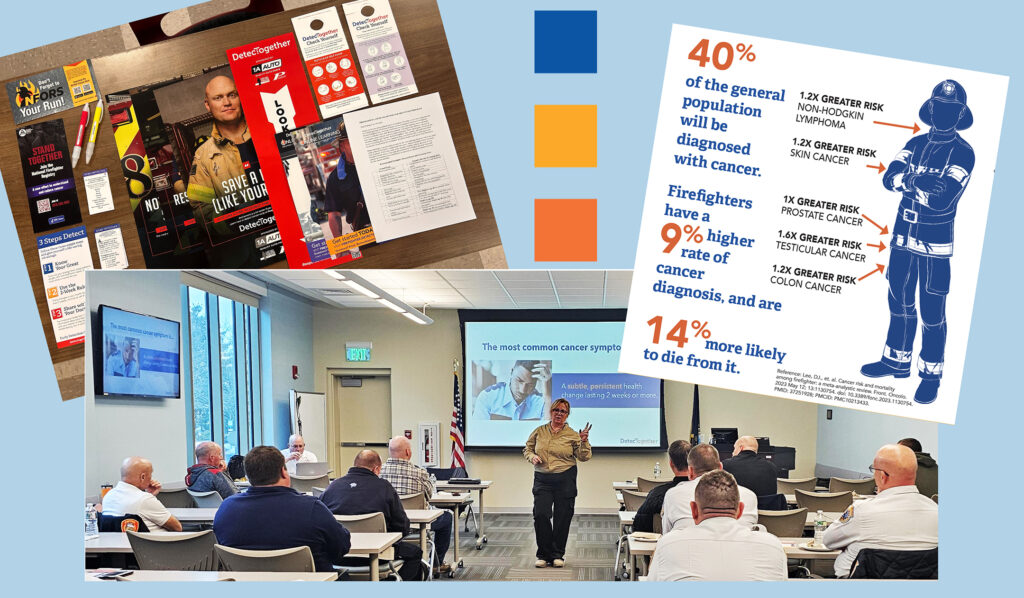
Firefighters face a higher risk of cancer compared to the general population, including cancers of the digestive, respiratory, and urinary systems.² Yet most firefighters are never taught how to recognize early warning signs or how to get answers in the healthcare system when something feels off.
That creates a dangerous assumption: people will just know when to act.
But early detection is not instinct. It’s a learned skill.
Firefighters don’t wait for absolute certainty on the fireground. They act based on indicators, experience, and preparation. Cancer requires the same mindset—but until recently, the fire service hasn’t had a framework for that kind of readiness. That’s how DetecTogether can be used as a resource.
What Actually Saves Lives
Evidence consistently shows that earlier diagnosis is associated with better outcomes.³ But “catching it early” doesn’t happen by chance. It requires:
Recognizing health changes early — understanding what’s normal, what’s not, and changes that deserve attention
Knowing how to navigate health care — how to talk with providers, ask questions, and advocate for next steps
Having the confidence to act — before symptoms worsen and before uncertainty turns into delay
These are skills. And like other lifesaving skills, they can be taught with 3 Steps Detect.
Moving Beyond Awareness
Firefighters deserve practical, evidence-based training that prepares them for one of the most serious risks of the job.
Not to promise prevention. Not to create fear. But to replace uncertainty with confidence—and hesitation with a plan.
Awareness turned into action will reduce cancer rates in the fire service and save lives.
This Firefighter Cancer Awareness Month, let’s move the conversation forward—from knowing the risk to being ready for it with 3 Steps Detect® training and taking action.
For more information:
About eLearning
About Our Programs
• Workplace Wellbeing
• First Responders
• Young Adults
• Community Education

1. Cancer Symptom Recognition and Anticipated Delays in Seeking Care Among U.S. Adults Rendle, Katharine A. et al. American Journal of Preventive Medicine, Volume 57, Issue 1.
National Institute for Occupational Safety and Health. (2017, May 10). Firefighter cancer facts. Centers for Disease Control and Prevention. https://blogs.cdc.gov/niosh-science-blog/2017/05/10/ff-cancer-facts
2. World Health Organization. (2025). Promoting cancer early diagnosis. World Health Organization. https://www.who.int/activities/promoting-cancer-early-diagnosis